
Yarn Weights Explained: Complete Crochet Yarn Guide
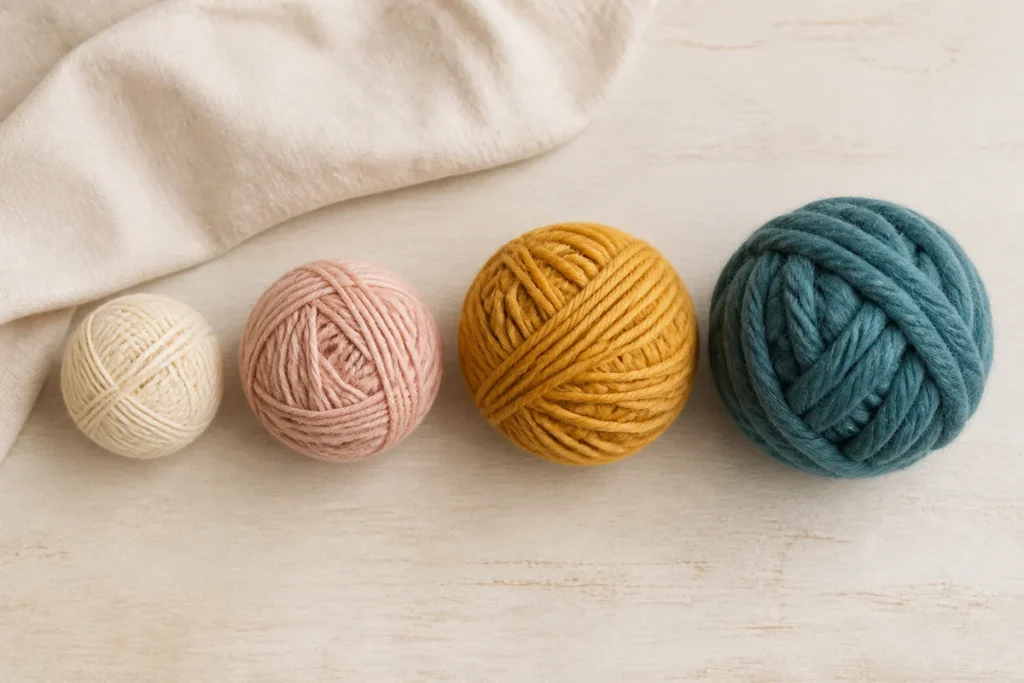
Yarn weight is a thickness category, not the weight of the ball. Use the standard number to narrow your choice, then compare fiber, yardage, care, and a washed swatch before committing to a project.
What yarn weight really means
In patterns and yarn labels, weight means the thickness category of the strand. It does not mean that every ball in one category weighs the same, and it does not guarantee identical gauge. Two category 4 yarns can differ in fiber, twist, density, yardage, and actual thickness.
The standard number and symbol provide a shared starting vocabulary. The project pattern’s gauge and the behavior of your swatch provide the final test.
The eight standard yarn-weight categories
| Number | Category | Names you may see | Common project character |
|---|---|---|---|
| 0 | Lace | Thread, lace, light fingering | Fine lace and delicate fabric |
| 1 | Super Fine | Fingering, sock, baby | Light garments, socks, detailed work |
| 2 | Fine | Sport, baby | Light accessories and garments |
| 3 | Light | DK, light worsted | Garments, baby items, flexible fabric |
| 4 | Medium | Worsted, afghan, aran | Versatile blankets, accessories, home projects |
| 5 | Bulky | Chunky, craft, rug | Fast, thick accessories and home projects |
| 6 | Super Bulky | Super bulky, roving | Very thick, fast-growing fabric |
| 7 | Jumbo | Jumbo, roving | Extra-large stitches and oversized projects |
How to read a yarn label
A useful yarn label normally provides more than the weight symbol. Look for:
- Fiber content: affects warmth, elasticity, drape, moisture behavior, and care.
- Net weight and yardage or meterage: tells you how much yarn is in the ball. Compare length, not just ball count.
- Weight category: the 0–7 thickness group.
- Suggested hook and gauge: a general starting recommendation, not a substitute for your pattern gauge.
- Dye lot: identifies yarn dyed in the same batch; color can vary between lots.
- Care symbols: washing, drying, ironing, and dry-cleaning instructions.
Keep one label until the project is finished. It preserves care directions and makes it easier to buy the same yarn.
How to choose yarn for a crochet project
- Follow the pattern’s required characteristics. Match weight category, approximate yardage, and intended fiber behavior.
- Think about the wearer or use. A dishcloth needs washable, absorbent yarn; a toy needs durable fabric; a garment needs suitable drape and care.
- Choose a color you can see. Beginners can identify stitches more easily in a smooth, light or medium color than in black, fuzzy, or highly textured yarn.
- Swatch. Pair the yarn with a sensible hook size, then evaluate gauge, texture, and drape.
| Fiber family | General traits | Considerations |
|---|---|---|
| Wool and animal fibers | Warm; many have elasticity and blocking memory | Care and sensitivity vary; some fibers felt with heat and agitation |
| Cotton and plant fibers | Often breathable, absorbent, and less elastic | Can feel heavier and may stretch under weight |
| Acrylic and synthetics | Widely available, durable, and often easy-care | Heat sensitivity and drape vary by yarn construction |
| Blends | Combine characteristics of multiple fibers | Use the exact percentage and care label to judge behavior |
How to substitute yarn without guessing
A successful substitute should produce the required gauge and an appropriate fabric without running short. Compare:
- weight category and the yarn’s apparent thickness;
- yards or meters per ounce/gram as a rough density comparison;
- fiber content, elasticity, texture, and care;
- the pattern’s total yardage, adding a sensible buffer for swatching and variation;
- the washed swatch’s size, drape, and recovery.
Do not replace yarn by ball count alone. One brand’s ball may hold much more or less yardage than another. For large projects, use the swatch method in the blanket planning guide.
What wraps per inch can—and cannot—tell you
Wraps per inch (WPI) estimates thickness by wrapping yarn evenly around a smooth tool without stretching or crowding it, then counting the strands in one inch. It is useful when a label is missing or when comparing yarns, but wrapping tension, yarn compression, and texture can change the result.
Measure several sections and treat WPI as supporting evidence, not a replacement for a gauge swatch. The Craft Yarn Council publishes a standard measuring method and category ranges.
Frequently asked yarn questions
Is worsted weight always category 4?
Worsted is commonly grouped in category 4 Medium, but names are not exact measurements. Compare the label, yardage-to-weight ratio, and swatch.
Can I crochet a pattern with a different yarn weight?
Changing the weight can alter size, drape, yardage, and structure. It is safest only when you recalculate the project or when the pattern explains how to adapt it.
What yarn is easiest for beginners?
A smooth, light-colored category 4 yarn is easy to see and widely supported by hooks and beginner patterns. Avoid yarn that is very fuzzy, splitty, dark, or irregular until you can identify stitches confidently.
Does a heavier yarn always make a warmer item?
Thickness influences fabric, but warmth also depends on fiber, stitch density, air trapped in the fabric, garment fit, and finishing.
Sources and standards
Technical terminology and sizing were checked against the following references:

