

Crochet Blanket Sizes: Planning, Yarn Amounts and Starting Chains
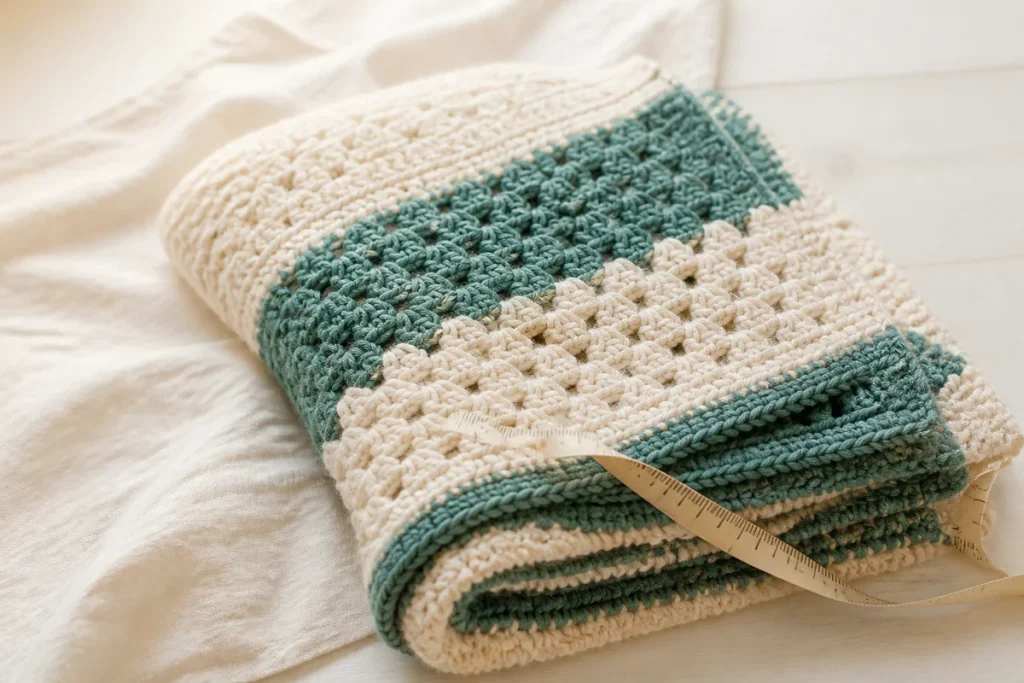
A successful blanket starts with a measured purpose rather than a generic chain count. Decide the finished dimensions, make a washed swatch, and let that swatch drive both stitch and yarn calculations.
Practical crochet blanket planning ranges
There is no single mandatory blanket-size standard. The ranges below are useful starting points in inches, but a custom measurement is more reliable. Bed blankets vary especially because mattress depth and desired side drop differ.
| Use | Common planning range (inches) | Measure before making |
|---|---|---|
| Lovey / comfort square | 12 × 12 to 18 × 18 | Intended use and recipient age |
| Stroller or small baby blanket | 30 × 36 to 36 × 40 | Stroller and supervised-use needs |
| Receiving-style blanket | 36 × 36 to 40 × 40 | Preferred wrapping or floor-use size |
| Lap blanket | 36 × 48 to 40 × 50 | Seated coverage |
| Throw | 50 × 60 to 54 × 65 | Sofa size and desired coverage |
| Twin bed top | About 60 × 85 | Mattress width/length plus desired drop |
| Full / double bed top | About 80 × 90 | Actual mattress and side drop |
| Queen bed top | About 90 × 95 | Actual mattress and side drop |
| King bed top | About 108 × 95 | Actual mattress and side drop |
Bed figures are examples, not shopping guarantees. Measure the mattress and decide whether the blanket covers only the top, hangs down the sides, or includes a pillow tuck.
Measure before choosing a pattern or stitch
- Write the target finished width and length.
- For a bed, measure mattress width, length, and depth. Add the desired drop to both sides of the width and to the foot of the length.
- Decide whether a border is included in those dimensions.
- Choose a stitch pattern and yarn that create the desired warmth, weight, drape, and washability.
- Make and wash a generous gauge swatch.
Calculate starting stitches instead of using a universal chain chart
Starting chains depend on your yarn, hook, tension, and stitch repeat. Calculate from the washed swatch:
- Divide swatch stitches by measured width to get stitches per inch.
- Multiply stitches per inch by the planned blanket width.
- Adjust the result to satisfy the stitch multiple and edge stitches.
- Add the pattern’s turning chains only if they are separate from the stitch count.
Example: 17 stitches measure 4 inches, so 17 ÷ 4 = 4.25 stitches per inch. A 50-inch width suggests 212.5 stitches. If the pattern needs a multiple of 4 plus 2 edge stitches, nearby valid totals are 210 (4 × 52 + 2) or 214 (4 × 53 + 2). Choose based on the preferred final width and whether a border will add width.
Estimate yarn with a weighed swatch
Generic yardage tables can be very inaccurate because stitch density, yarn construction, border, and tension all change use. A weighed, washed swatch gives a project-specific estimate:
- Make a representative swatch in the final stitch pattern.
- Measure its usable width and height, then multiply to get swatch area.
- Weigh the dry swatch on a scale accurate to at least 1 gram.
- Calculate blanket area and divide by swatch area.
- Multiply that ratio by swatch weight.
- Convert required grams to skeins using the label’s net weight, then add a buffer for border, joining, swatching, and variation.
Example: a 10 × 10 inch swatch has 100 square inches and weighs 35 g. A 50 × 60 inch throw has 3,000 square inches—30 times the area—so the center fabric estimate is about 1,050 g. Add the planned border and a practical margin. Use label yardage as an additional cross-check and buy the same dye lot when possible.
Plan granny-square and motif blankets
Block and measure one representative motif. Divide target width and length by the finished motif dimensions, then round to whole squares. Include the join’s width and any border.
For example, a blocked 6-inch square arranged 8 by 10 creates a motif field near 48 × 60 inches before seams and border. Make several motifs first because the first square may differ as your tension settles. Follow the granny-square guide for consistent corners and finishing.
Allow for borders, stretch, weight, and washing
- A border adds width and length; subtract its planned depth from the center dimensions.
- Large plant-fiber blankets may stretch under their own weight.
- Dense stitches and heavier yarn can make a bed-size blanket difficult to handle and wash.
- Test laundering on the swatch and confirm that the finished blanket fits available washing and drying equipment.
- Record yarn labels and dye lots until the project is complete.
Important note about blankets and infant sleep
A handmade baby blanket can be used for supervised floor time, stroller use as appropriate, or as a keepsake, but it should not be placed as loose bedding in an infant sleep space. The U.S. Consumer Product Safety Commission’s current safe-sleep guidance says “Bare is Best”: use only a fitted sheet in a crib, bassinet, or play yard, and do not add blankets or pillows. Caregivers should follow current pediatric and local safe-sleep guidance.
Frequently asked blanket questions
How many chains do I need for a 50-inch blanket?
There is no reliable universal number. Multiply your washed stitch gauge per inch by 50, then adjust to the stitch pattern’s required multiple and edge stitches.
How much yarn does a crochet blanket need?
It depends on size, stitch, yarn, hook, and tension. Weigh a representative swatch and scale its area, then add a buffer for borders and variation.
What size is a crochet throw?
About 50 × 60 inches is a common planning point, with ranges around 50–54 inches wide and 60–65 inches long. Customize it to the sofa and recipient.
Should I wash a blanket swatch?
Yes. Washing reveals changes in size, drape, color behavior, and texture before you commit to a large amount of yarn.
Sources and standards
Technical terminology and sizing were checked against the following references:


