
Crochet Gauge Explained: How to Measure and Fix Your Swatch
Gauge is the bridge between a designer’s instructions and your hands. A measured, washed swatch tells you whether your yarn, hook, and technique will produce the intended size and fabric.
What crochet gauge means
Gauge describes the density of your crochet: a specified number of stitches and rows or rounds over a stated measurement in a particular stitch pattern. A pattern might say, “16 sc and 18 rows = 4 in / 10 cm in single crochet after blocking.” Every part matters—the stitch, measurement, treatment, and direction.
Matching gauge helps reproduce finished dimensions and estimate yarn use. It is essential for fitted garments and useful for hats, toys, motifs, and planned blanket sizes. A decorative scarf may tolerate more variation, but its drape and yardage will still change.
How to make a reliable gauge swatch
- Use the project’s yarn, stated hook, and exact gauge stitch pattern.
- Make the swatch larger than the area you need to measure. For a 4-inch measurement, aim for a piece at least 6 inches wide and tall so edges do not distort the reading.
- Work enough rows to settle into your natural tension. Do not force yourself to crochet unusually tightly or loosely.
- Wash and dry or block the swatch exactly as the finished project will be treated, if the pattern measures blocked gauge.
- Let the swatch rest and dry completely before measuring.
If the project is worked in the round, swatch in the round when possible. Flat and round tension can differ, and turning can change stitch texture.
How to measure stitch and row gauge
- Lay the dry swatch flat on a firm surface without pinning or stretching it.
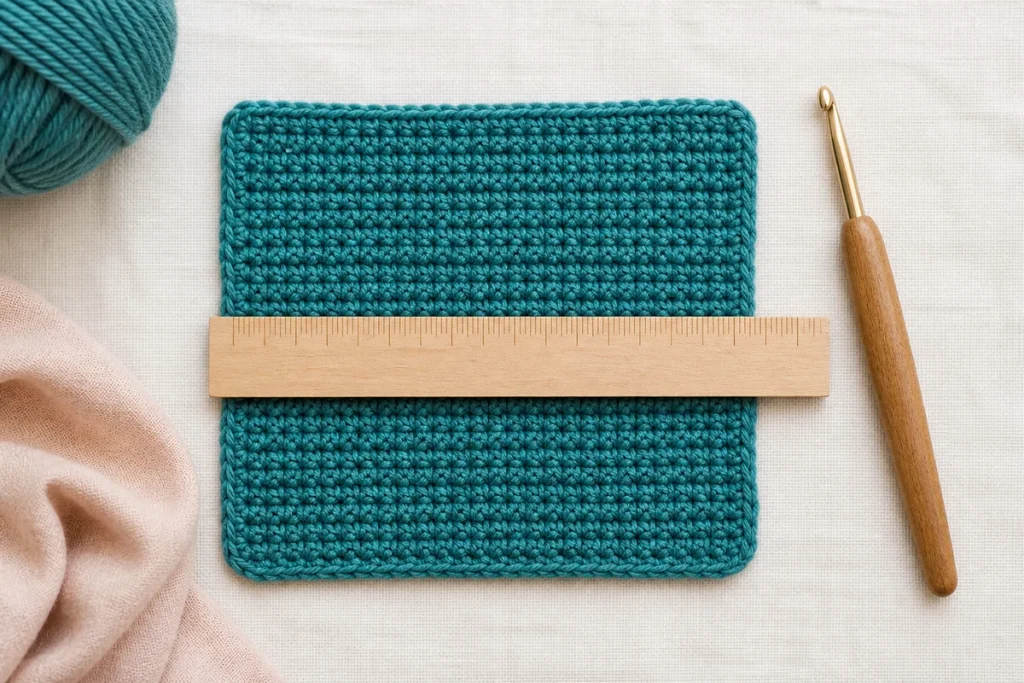
- Place a rigid ruler across the center, away from the foundation and edges.
- Count complete stitches across the stated width. Partial stitches can be recorded as halves or quarters when visible.
- Turn the ruler vertically and count rows over the stated height.
- Measure in more than one place and compare the readings.
Example: if 18 stitches measure 4.5 inches, the stitch gauge is 18 ÷ 4.5 = 4 stitches per inch. If you need a 20-inch panel at that gauge, an initial planning estimate is 4 × 20 = 80 stitches, adjusted for the stitch pattern’s required multiple and edges.
What to change when gauge is wrong
| Your result | What it means | First controlled test |
|---|---|---|
| Too many stitches in the stated width | Your stitches are too narrow | Try a larger hook. |
| Too few stitches in the stated width | Your stitches are too wide | Try a smaller hook. |
| Stitch gauge matches, too many rows | Your rows are too short | Pay attention to the height of the loop you pull up; changing hook alone may disrupt stitch gauge. |
| Stitch gauge matches, too few rows | Your rows are too tall | Test a lower first loop or plan row adjustments if construction allows. |
Change one variable, label the new swatch, and measure again. If several hook changes still produce unsuitable fabric, the yarn may not be a good substitute. Review both hook sizing and yarn characteristics.
Use gauge to estimate stitches and finished size
Convert the swatch to a per-inch or per-centimeter rate before planning:
- Stitches per inch = measured stitches ÷ measured width.
- Estimated stitches needed = target width × stitches per inch.
- Estimated finished width = stitch count ÷ stitches per inch.
Round to a number that satisfies the stitch pattern multiple. For example, a repeat of 4 stitches plus 2 edge stitches requires a total in the form 4n + 2. Do not blindly round if shaping or motif counts control construction.
Gauge numbers are not the only quality check
A technically matching swatch can still be too stiff, too open, too heavy, or unsuitable after washing. Compare drape, opacity, stitch definition, recovery, and care. If reaching gauge creates bad fabric, choose a more suitable yarn or recalculate with a fabric you like rather than forcing the project.
Frequently asked gauge questions
Do I have to make a gauge swatch?
For fitted, assembled, or yarn-intensive projects, a swatch is the safest approach. For an item where exact size and yarn use do not matter, you can choose to skip it while accepting the risk.
Should I count the edge stitches?
No. Measure in the center of a swatch larger than the required area because foundation, turning, and edge tension can distort the count.
Why did my gauge change after washing?
Fibers and stitch structures can relax, grow, contract, or bloom during washing. The finished project will be washed too, so post-wash measurements are often the useful ones.
Can I fix row gauge without changing stitch gauge?
Sometimes. The height of the loop you pull up affects row height. Construction may also allow you to work more or fewer rows, but shaping and yardage must be checked.
Sources and standards
Technical terminology and sizing were checked against the following references:


