
Crochet Stitches for Beginners: The Essential Stitch Library
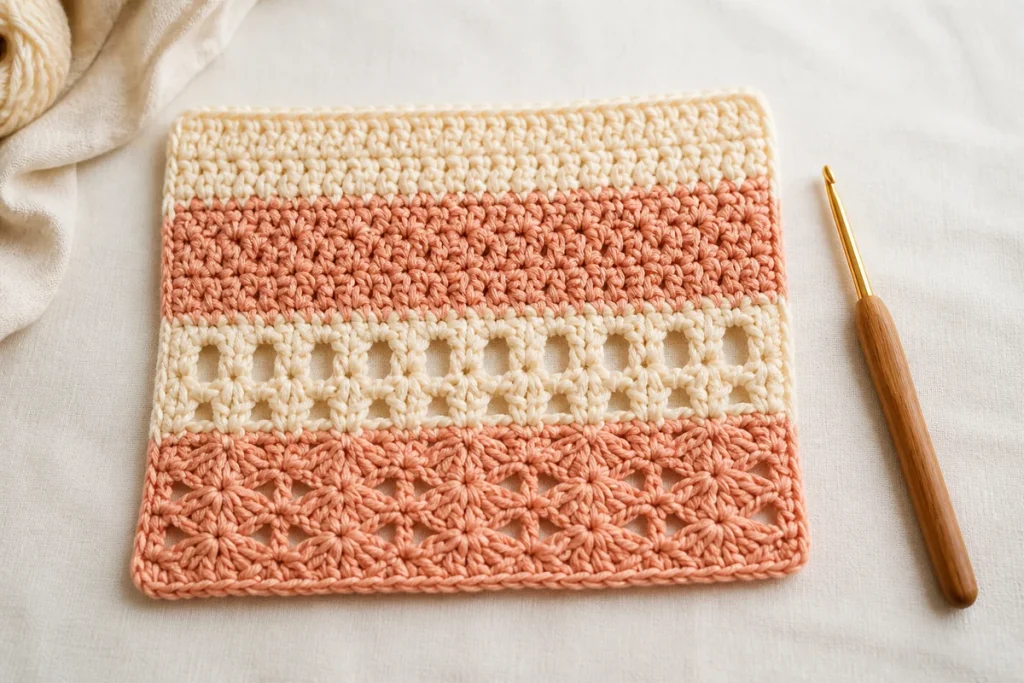
Most basic crochet stitches use the same three movements—yarn over, insert the hook, and pull through loops. Learning how the loop count changes makes new stitches much easier to understand.
Before you begin: terminology and anatomy
This guide uses standard U.S. crochet terms. U.K. terminology shifts many names: for example, a U.S. single crochet is a U.K. double crochet, and a U.S. double crochet is a U.K. treble. Confirm the system before following any pattern.
The top of a completed stitch normally forms a V with a front loop and back loop. When a pattern says “in the next stitch” without another instruction, work under both loops. Working in only one loop changes the texture and stretch.
Beginner crochet stitch comparison chart
| U.S. stitch | Abbreviation | Loops after pulling up a loop | General fabric character |
|---|---|---|---|
| Slip stitch | sl st | 2, then pull first loop through second | Very short; useful for joining and surface movement |
| Single crochet | sc | 2 | Short, firm, and dense |
| Half double crochet | hdc | 3 | Medium height with a softly ridged texture |
| Double crochet | dc | 3, reduced in two stages | Taller, faster, and more open |
| Treble crochet | tr | 4, reduced in three stages | Very tall, drapey, and open |
How to make the five essential stitches
Slip stitch (sl st)
- Insert the hook in the indicated stitch or space.
- Yarn over and draw the yarn through the stitch and the loop already on the hook in one motion.
Keep slip stitches loose enough to work into later. They are often used to join a round, move across stitches without adding much height, or create surface details.
Single crochet (sc)
- Insert the hook in the next stitch and yarn over.
- Pull up a loop; two loops are on the hook.
- Yarn over and pull through both loops.
Single crochet makes compact fabric and is the foundation of many amigurumi projects.
Half double crochet (hdc)
- Yarn over, then insert the hook in the next stitch.
- Yarn over and pull up a loop; three loops are on the hook.
- Yarn over and pull through all three loops.
The extra yarn over creates a third horizontal strand in the stitch anatomy. Designers sometimes work into that strand for a knit-like texture.
Double crochet (dc)
- Yarn over and insert the hook in the next stitch.
- Yarn over and pull up a loop; three loops are on the hook.
- Yarn over and pull through two loops.
- Yarn over and pull through the remaining two loops.
Double crochet is tall enough to build fabric quickly and is central to the traditional granny square.
Treble crochet (tr)
- Yarn over twice before inserting the hook.
- Insert in the next stitch, yarn over, and pull up a loop; four loops are on the hook.
- Yarn over and pull through two loops three times.
Because treble stitches are tall, uneven tension is more visible. Practice keeping the yarn overs the same size.
Turning chains and straight edges
A turning chain raises the hook to the height of the next row. Whether it counts as the first stitch depends on the pattern and stitch. Many modern patterns use chain 1 for single crochet without counting it as a stitch; double-crochet patterns may use chain 2 or 3 and may or may not count it. Follow the pattern’s explicit note.
If the turning chain does not count, work the first stitch in the first stitch of the row. If it does count, the next stitch is usually worked in the following stitch, and the turning chain may be worked into at the end of the next row. Marking the edge prevents accidental increases and decreases.
How to choose a stitch for a project
- Dense fabric: single crochet is useful for baskets, sturdy accessories, and stuffed shapes.
- Balanced warmth and drape: half double crochet works well for simple scarves, hats, and blankets.
- Fast, flexible fabric: double crochet suits wraps, open blankets, and motif work.
- Open lace or extra height: treble crochet creates long vertical lines.
Fiber, yarn weight, hook size, and tension can change the behavior of any stitch. Make a swatch and follow the project’s crochet gauge when size matters.
Common stitch mistakes and fixes
| Symptom | Check | Fix |
|---|---|---|
| Stitch count changes | First and last stitches | Mark both edges and count after every row. |
| Stitches are hard to enter | Loop size and hook placement | Relax the working yarn and work on the hook shaft, not the narrow throat. |
| Fabric looks unexpectedly ridged | Which top loops you used | Unless directed otherwise, insert under both top loops. |
| Stitch is the wrong height | Initial yarn overs and pull-through groups | Count loops after pulling up a loop and repeat the sequence slowly. |
Frequently asked stitch questions
What crochet stitch should a beginner learn first?
Learn chain and single crochet first. Once you can identify the top of a stitch and keep a steady count, half double and double crochet use familiar motions.
What is the easiest crochet stitch for a blanket?
Single, half double, and double crochet are all beginner-friendly. Half double or double crochet grows faster, while single crochet creates denser fabric and uses more stitches for the same height.
Why are my crochet edges uneven?
The most common cause is adding or skipping edge stitches. Confirm whether the turning chain counts and mark the first and last stitch.
Do crochet abbreviations always mean the same thing?
No. U.S. and U.K. systems use some of the same names for different stitches. Always identify the terminology used by the pattern.
Sources and standards
Technical terminology and sizing were checked against the following references:


